
Well, the market didn’t care what I had to think.
NEWS TO KNOW
Software stocks got absolutely crushed this past week.
There’s a fear that AI will make it easier than ever to build competitive solutions. And the MOAT of each is quite low.
ISV (Software ETF) is down 20% over the last 6 months.
Best value ever? Or are they going lower?
📚 – AEs should write out the narrative… with buyers
BEST FROM LAST WEEK
📝 – 6 Keys for a Full Cycle Seller
💸 – Stop Losing in Negotiations
Two Ways to Win, When You’re Not the Only Option
Most sellers get disappointed when they realize their deal is competitive.
Mid-cycle during a demo the prospect casually drops, “We’re looking at a couple other solutions too.”
Most reps panic and start feature-comparing.
The key is knowing which game you’re playing and how to win it.
There are really only two scenarios you’ll find yourself in, and each requires a completely different playbook.
Scenario 1: You’re the Premium Option (And Proud of It)
You cost more. Maybe a lot more.
Your prospect is doing mental math wondering if you’re worth it.
This is actually a good position (and the one I’ve personally been in all my career) to be in if you play it right.
Your Mission: Make the math obvious. Show them why NOT buying from you costs more than buying from you.

The Premium Playbook:
Step 1: Quantify Their Pain
Don’t ask generic discovery questions.
Get specific about what their current situation is costing them.
Try a version of this: “Walk me through what happened last quarter when you couldn’t get visibility into pipeline. How much revenue slipped because deals stalled?”
Not this: “What challenges are you facing?”
Step 2: Size the Opportunity
Get them to put a number on solving this problem perfectly.
“If you could eliminate those pipeline blind spots completely, what would that mean for your quarterly numbers?”

Step 3: Connect Your Solution to Their Money
This is where most reps blow it.
They say something like “Our advanced reporting dashboard has the ability to do ___ and they do not.”
Instead: “You just told me pipeline visibility issues cost you $200K last quarter. Our client TechCorp had the same problem. Our platform helped their VP of Sales spot at-risk deals 3 weeks earlier.
They closed 18% more deals last quarter.
The $40K difference in price paid for itself in month one.”
The Premium Close:
“Based on what we’ve discussed, if you don’t solve this problem this year, it’ll cost you roughly $800K.
If our solution helps you capture even half of that opportunity, the investment makes sense, right?
What would you need to see to move forward?”
Scenario 2: You’re the Value Option
You’re cheaper, but you’re worried they think “cheap” means “worse.” Time to flip that script.
Position yourself as the smart, practical choice that gets stuff done.
Your Mission: Show them they’ll get everything they actually need without paying for stuff they don’t.

The Value Playbook:
Step 1: Identify What They Really Need
Most prospects think they need everything. Help them focus on what actually moves the needle.
“Of all the capabilities you’ve mentioned, which three would have the biggest impact on your team’s performance if we nailed them perfectly?”
Step 2: Position Them as Overkill
Don’t badmouth the competition.
Just question whether all those bells and whistles make sense.
“I see you’re also looking at [Premium Competitor]. They build a really robust platform – probably the Lamborghini of our space.
But let me ask you: for your use case, do you think that’s what you require?”
Step 3: Make Complexity the Enemy
Premium solutions often come with complexity.
Use that against them.
“How important is it that your team can start seeing results quickly? Because I notice complex platforms sometimes take 6-9 months to show ROI. Our clients typically see value in the first 30 days.”
The Value Close:
“Look, you could spend 60% more and get every feature under the sun.
But you told me your priorities are X, Y, and Z.
We nail those three things really well, and you’ll save enough money to hire another team member.
Which approach gets you to your goals faster?”

The Positioning Game
Here’s what’s really happening in every competitive deal: you’re not just selling against their features or price.
You’re selling against their story.
If you’re premium: Their story is “good enough for less money.” Your counter-story is “you buy cheap, you buy twice”
If you’re value: Their story is “premium features and capabilities.” Your counter-story is “practical solutions that actually get used.”
The Questions That Position Your Competition:
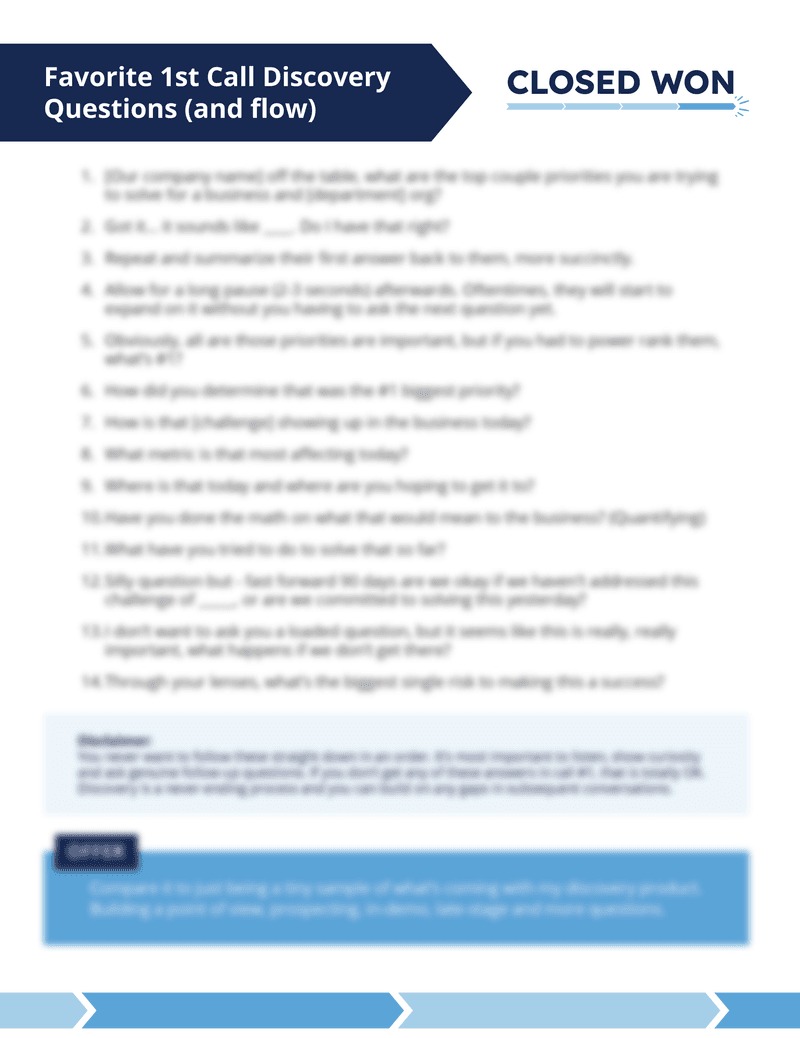
Final Thoughts
Competitive deals aren’t won by having the best product.
They’re won by being the best fit for what the prospect actually needs.
The premium option wins when the prospect believes the extra cost pays for itself.
The value option wins when the prospect believes they’re being smart with their money.
Which game are you playing?