
Anthropic is in talks to raise at a $900B valuation.
BEST FROM LAST WEEK
Once upon a time, Dario Amodei left OpenAI and Sam Altman.
And now he’s in first place.
📚 – Me on “Be Better Tribe” (20 min podcast)
BEST FROM LAST WEEK
📝 – 5 ways to ask for next steps without being needy
💸 – Top 25 companies for quota attainment
The Lost Art of Patience
Everyone in sales is obsessed with speed right now.
Faster cycles. Better velocity. Move deals through the stages.
Your CRM is basically a pressure cooker designed to push opportunities forward as fast as possible.
And look, for transactional deals? Speed makes sense.
But for your most important enterprise accounts, rushing is one of the most expensive mistakes you can make.
The reps consistently winning big deals have figured out something counterintuitive: the longer you hang out early stage, the faster you close later.
Counterintuitive Framework: Front-Load Everything
Here’s how most reps approach a key account:
Discovery call → Demo → Proposal → Negotiate → Close
And here’s why that approach gets wrecked at the finish line. By the time you’re in front of a CFO or CEO, you’re showing up with a point of view built on two or three conversations.

You don’t know the org. You don’t know the internal politics. You don’t know what failed before you walked in the door.
The better approach looks like this:
Initial discovery → Wider discovery → Deeper discovery → Demo → Executive Demo
The goal is to stay in Stage 1 or Stage 2 for as long as it takes to actually understand the business. Your manager might push back on this. Pipeline velocity is a real metric and leadership watches it.
But a deal that closes is worth a lot more than a deal that accelerates into a lost opportunity.
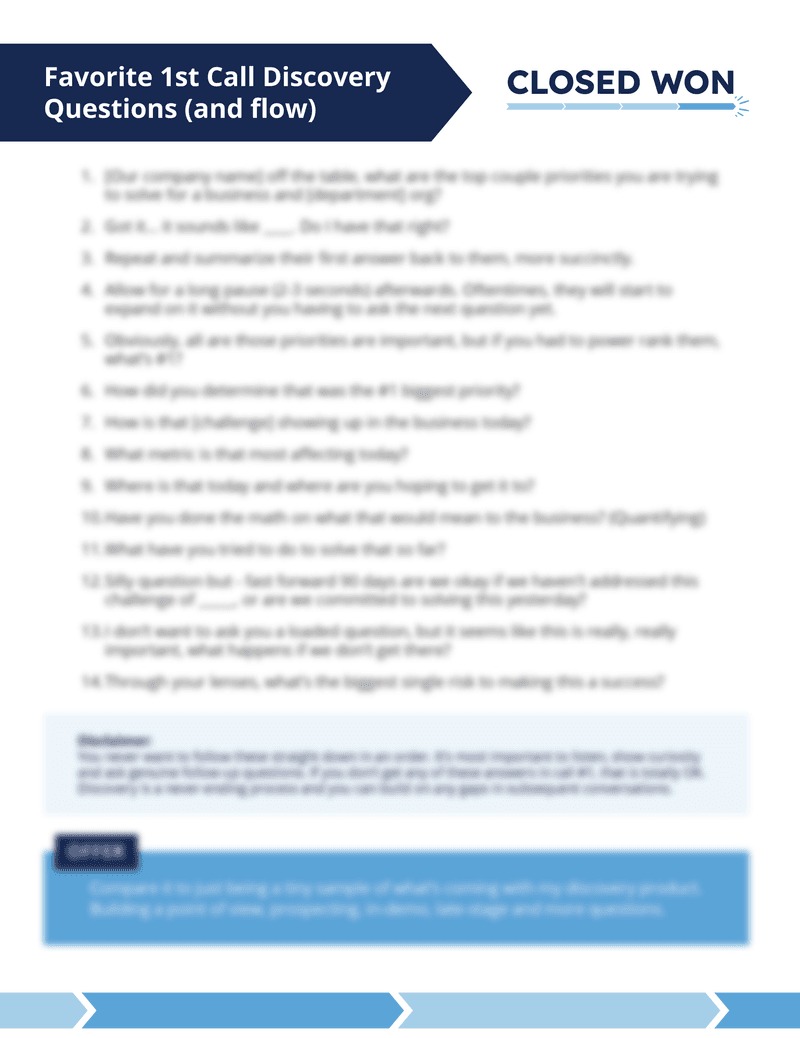
What “Deep Discovery” Actually Looks Like
This isn’t just asking better questions on your first call. It’s a deliberate, multi-threaded strategy.
Here are four moves worth running on every major account:
1. The Reverse Demo Instead of showing your product, create a dedicated session to have the prospect walk you through their actual day-to-day. Screen share, their tools, their workflow. Something like: “Before I show you anything, can you show me how you operate today?”
You’ll learn more in 30 minutes than in three traditional discovery calls. You’ll spot inefficiencies they’ve stopped noticing.
You’ll hear the language they use internally, which you can mirror back later.
2. The Stakeholder Crawl Book short 20-minute exploratory sessions with multiple people across the org. Not to sell. Just to understand. Each conversation adds a layer.
A useful ask for your champion: “Who else in the business would have a strong opinion on this if it moved forward? We’d love to hear their perspective early in addition to yours.”
3. The Horizontal Expansion If you started with sales leadership, go find marketing. Go find ops. Go find business development. Enterprise deals rarely live in one department, but they often get sold that way.
Mapping the full blast radius of your solution early gives you a much richer story later.

4. The Pre-Mortem Conversation At some point in early discovery, ask your champion: “What’s made similar initiatives stall or fail here in the past?” This is gold.
It tells you the landmines to avoid and the internal skeptics you’ll need to get ahead of.
What Happens When You Do This Right
By the time you eventually land in front of the economic buyer or a C-suite decision maker, you’re not showing up with a deck and a prayer.
You’re showing up with:
- Specific pain points pulled from six different conversations across the org
- An understanding of what’s been tried before and why it didn’t work
- Internal language and framing that resonates because you heard it from their own people
- Champions in multiple departments who already have context and skin in the game
At that point, the meeting feels less like a pitch and more like a conversation between people who already understand the problem together.

The deal doesn’t drag from there. It accelerates.
The Mindset Shift
Patience in enterprise sales is about being intentional in using early access to build the strongest possible position before you ever ask for a decision.
The reps who skip this step are always the ones shocked when a deal they thought was done falls apart in the final stage.
The reps who embrace it tend to have a very different problem: deals that seem to close themselves.
Go slow early. Go fast when it matters.
Gong’s EOQ was 4/30 – I hit over my goal, but am not happy at all with the result.
Didn’t even crack the top 15 for my org – which is a testament that I’m in the right place for sure and the opportunity is there.
More internal fire than ever before…